10 Topic Cluster Generator Tools Compared for 2026
Compare 10 topic cluster generator tools for SEO and planning, with honest limits, use cases, and tips on turning clusters into a content plan.
Two teams pull the same 4,000-keyword export. One runs it through a tool that groups terms by shared ranking URLs and comes out with 58 pages, each tied to a specific query set. The other pastes the same file into a tool that groups by meaning and gets 21 clusters, several of which visibly overlap. Both teams now believe they have a site structure.
The difference isn't quality. It's the modeling decision underneath. One tool compares Google results and asks which keywords return the same pages. Another compares word vectors and asks which phrases sit close together in semantic space. A third reads your Search Console queries and asks what your site already half-ranks for. Three different questions, three different answers, and no single tool that answers all of them well.
Topic modeling has a long academic tail. Latent Semantic Analysis arrived in 1990, and Latent Dirichlet Allocation followed in 2003 from Blei, Ng and Jordan, as traced in this survey of topic modeling methods. Every commercial clustering tool is a practical descendant of that work with a different similarity measure bolted on.
So the tools below are sorted by the input they need (a blank topic, a keyword export, a Search Console property, an existing site) and by what they hand back when clustering finishes. That's the choice that changes your site.
Table of Contents
- 1. Topic Cluster Generator
- 2. Keyword Clusters
- 3. SEOcluster.ai
- 4. Semrush Keyword Strategy Builder
- 5. Keyword Insights
- 6. Keyword Cupid
- 7. thruuu Keyword Clustering
- 8. Senuto Content Planner
- 9. MarketMuse
- 10. Ahrefs Keywords Explorer
- How the ten tools differ by starting input, free access, and best use
- Match the Tool to Your Input, Then Check the Output
1. Topic Cluster Generator
Most generators demand a keyword list before they'll do anything. This one opens with a blank box and works whether or not you have data.
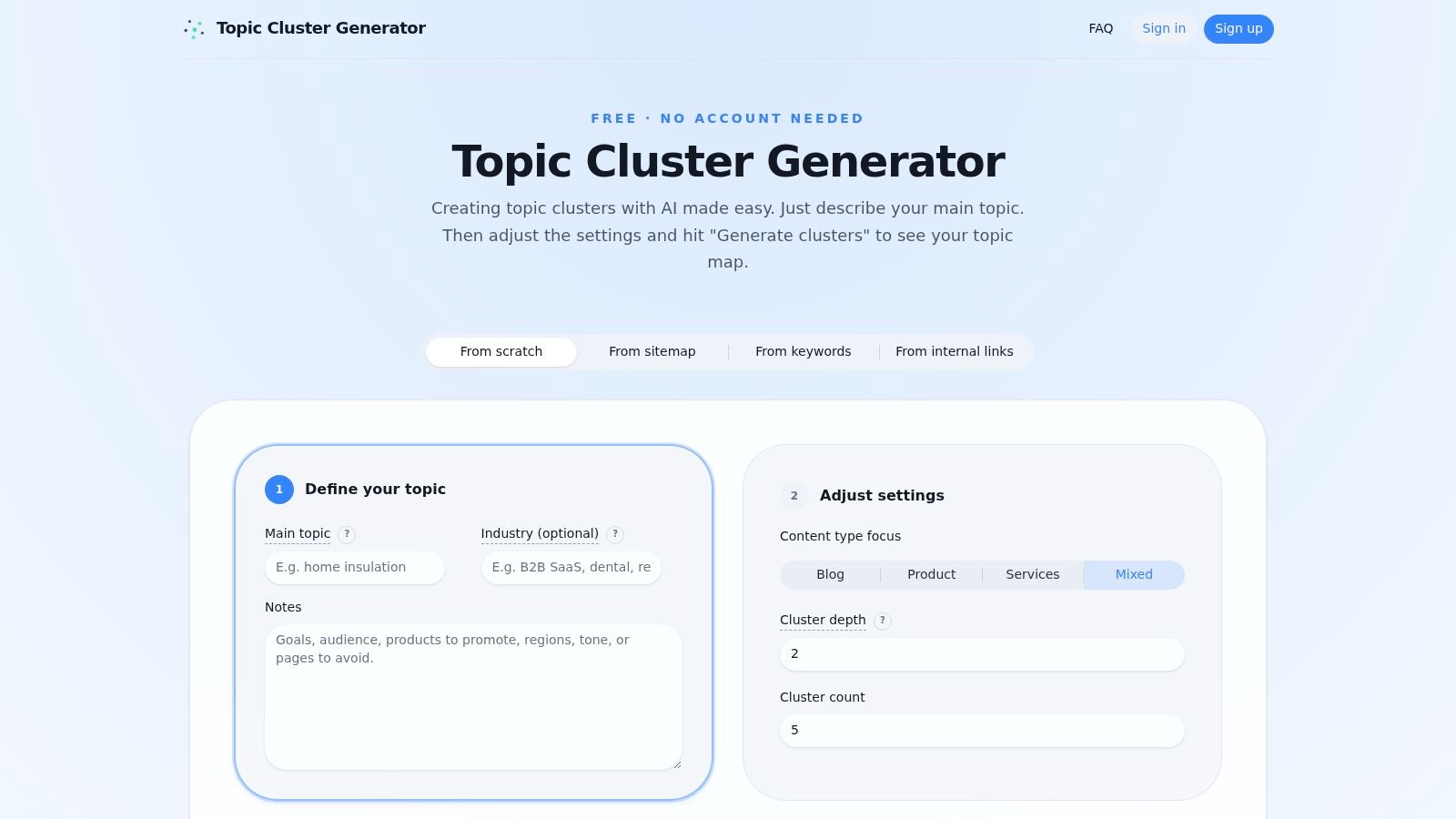
Topic Cluster Generator is free and needs no account. It accepts a topic prompt, a sitemap, a pasted keyword list, or internal-link data, so the same interface handles brainstorming a brand-new structure and mapping what a live site already covers.
Where the AI stops and the browser starts
Two different mechanisms run here. Idea generation uses a model to propose pillar and supporting-page angles, optionally with industry context. Keyword and title clustering runs in your browser using TF-IDF. That split matters for client data: the clustering stays on your machine, the idea generation doesn't, so don't describe the whole workflow as local.
- Visualizations: treemap, tree chart, circle packing, and a 3D graph. More useful than it sounds when you're checking whether a pillar has enough supporting depth.
- Exports: CSV download plus time-limited share links for sending a map to a writer or a client.
- Constraint: it needs JavaScript, and it's built for site architecture rather than social publishing.
The ideas it returns aren't validated keyword research. Treat them as hypotheses to check against volume and live results. A blank-topic run gives you candidate pillars and support pages; a sitemap run gives you gaps and overlap in pages that already exist. The output still needs a human pass before it becomes a brief, because similar phrasing can hide different intent and a convincing cluster can still be thin on demand.
Repurposing comes later anyway: in Databox's 2024 content marketing and SEO survey, 43.70% of respondents said they repurposed long-form SEO content for social media (Databox). This tool stops well before that step. Before anyone writes, map the handoff in a content workflow diagram so review, approval, and scheduling have named owners rather than floating between the cluster export and the calendar.
2. Keyword Clusters
If you already own the keyword list, the only question left is where to cut it.
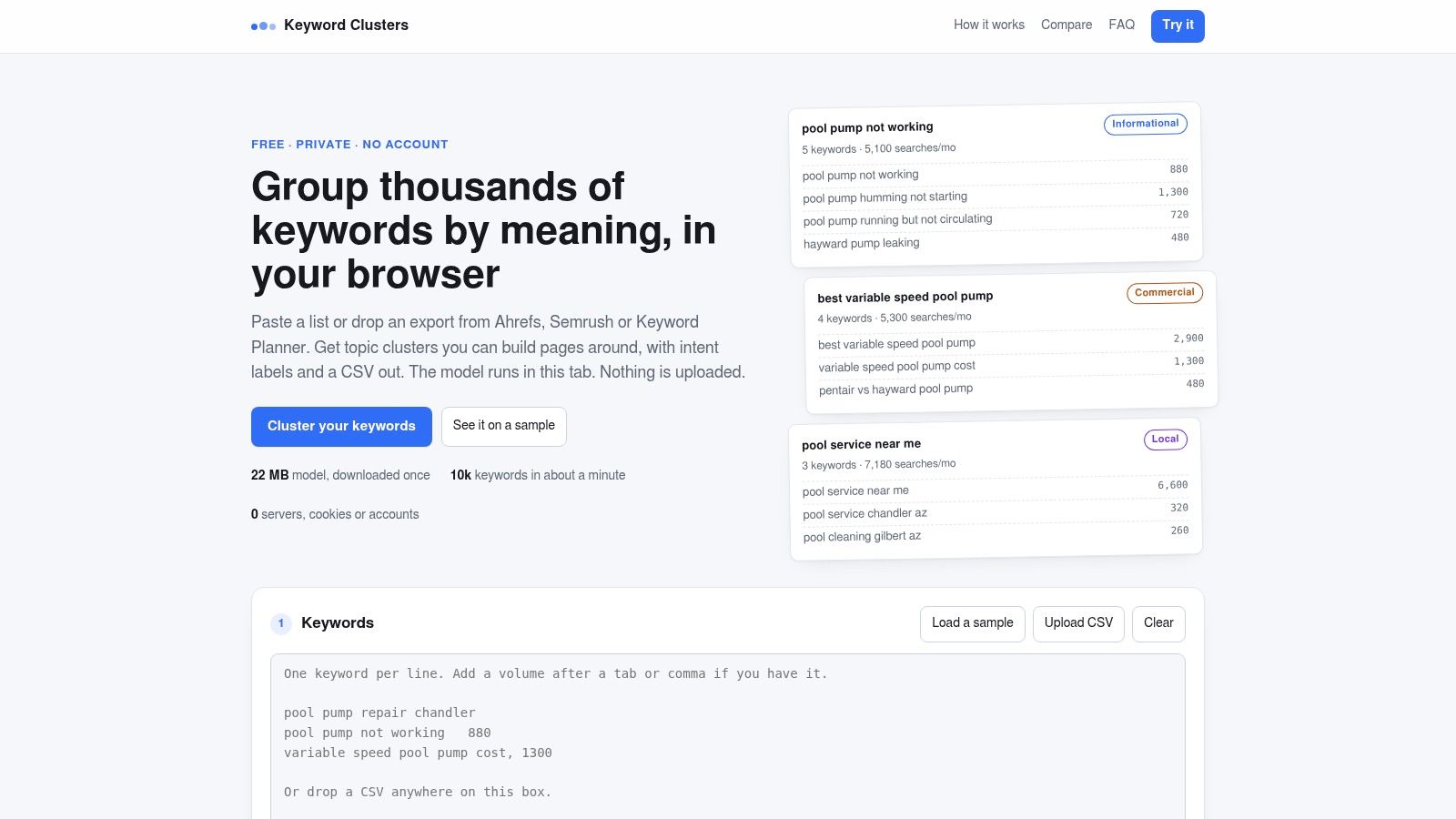
Keyword Clusters starts from pasted keywords or an export from a common SEO tool and returns cluster labels, estimated search intent, and a downloadable file. The site says it handles up to 25,000 keywords per run using an in-browser sentence-embedding model, so the file stays on your device.
Similar meaning can still split on the results page. Spot-check each cluster against live results before you assign it a URL.
That check is the whole job. Two phrases can sit close together in an embedding and still return different result types. One wants a definition. The other wants a comparison table, a product page, or a local pack.
The intent labels are rule-based estimates, so treat them as a first pass. AI Overviews also cite pages from outside the traditional top 10 often enough that a tidy semantic group can still miss the URLs that get surfaced.
Where it earns its place is speed on a raw export. Paste 12,000 terms, get a rough structure in minutes, then spend your time on the clusters that carry commercial weight. CSV export and copy-to-clipboard make it easy to move the output into Sheets and annotate by hand. The workflow stops at the grouped file; calendar planning, briefs, and social reuse stay with your usual process.
3. SEOcluster.ai
Most tools guess what your site should cover. This one starts from what Google already shows your site ranking for.
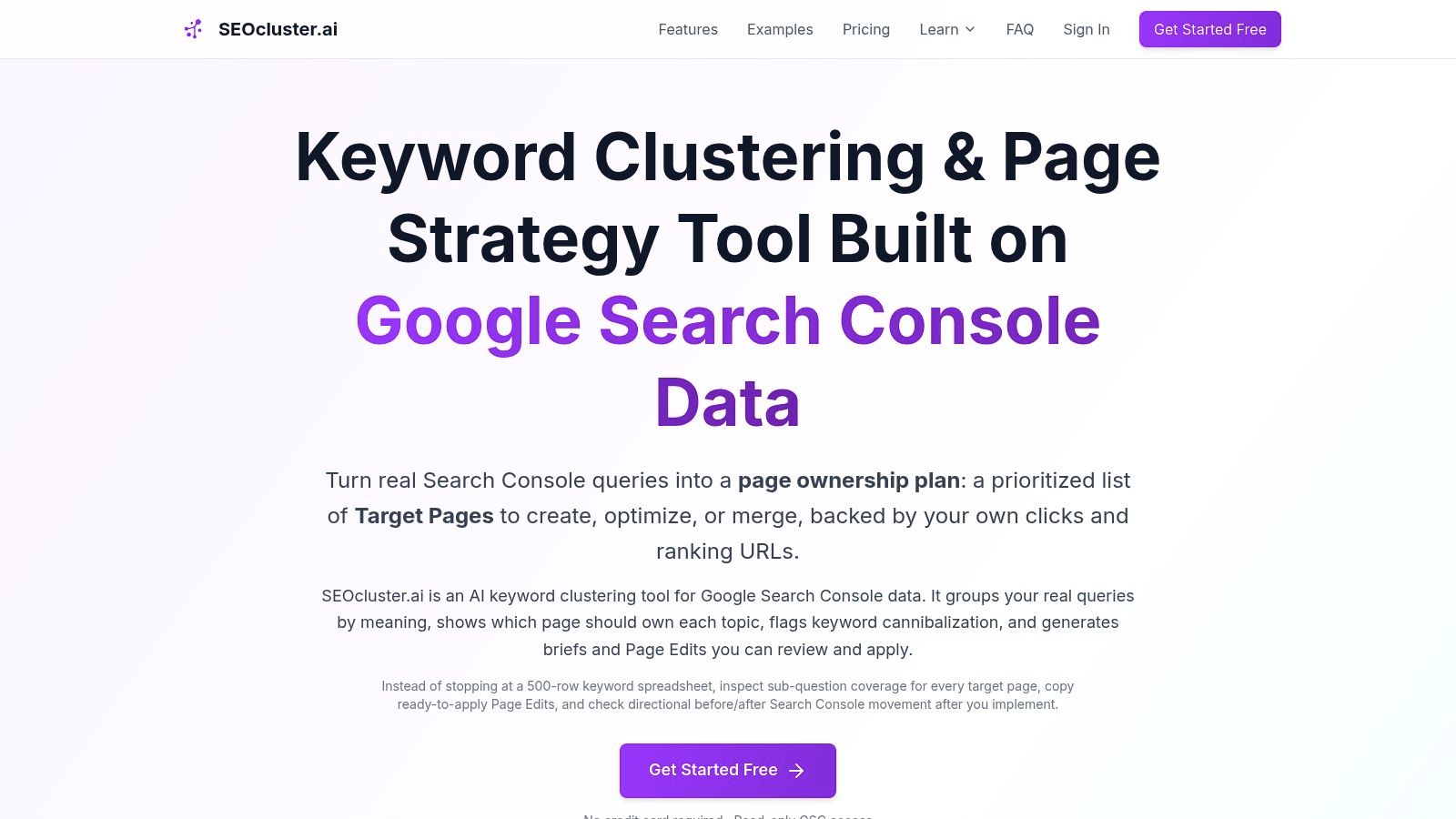
SEOcluster.ai connects to Search Console with read-only access, groups your queries into clusters, and ties each cluster to an existing URL with a recommended page action. That makes it a consolidation tool as much as a generator. The free tier covers one Search Console property, 1,500 keywords per dataset, and three clustering runs a month.
The cost of starting from your own data
Search Console only shows queries where you already have impressions. A topic you've never touched won't appear, however valuable it is. The output is a map of your current footprint, not a map of the market.
- Use it for cannibalization first: two URLs splitting the same query set is the most expensive problem in most content libraries, and this surfaces it quickly.
- Use the briefs second: brief and draft generation sit on paid tiers, and generated drafts still need an editor who knows the subject.
- Skip it if you're starting from zero: without a property and some history, there's nothing to cluster.
The grouping is the reliable part. The recommendations are a starting position for a human who can see the commercial context behind a query. Budget review time for every cluster you accept, because a page action suggested by a query pattern can be wrong about intent.
4. Semrush Keyword Strategy Builder
Seed keywords in, pillar and subpage structure out, with metrics attached to each grouping.
Semrush's Keyword Strategy Builder creates topic, pillar-page, and subpage groupings from up to five seed keywords and ranks opportunities by relevance, search volume, keyword difficulty, domain diversity, and SERP features. It sits inside the paid SEO Toolkit, so it's a sensible pick only if you're already there for other reasons.
Volume stops being a proxy for clicks
The prioritization logic assumes ranking equals traffic. That assumption is weakening. Google AI Overviews appeared on 13.14% of U.S. desktop searches in March 2025, up from 6.49% in January, based on an analysis of more than 10 million keywords, and a Pew analysis found users clicked a traditional result in 8% of searches containing an AI summary against 15% without one. Links inside summaries drew clicks in just 1% of visits, according to the same Search Engine Land report.
A cluster built purely on volume will over-invest in topics that get summarized and under-invest in topics that create a reason to visit: original data, tools, implementation detail, and buying decisions.
Five seed keywords is also a real constraint. You'll run the builder several times and stitch the results together yourself, which means the final architecture is your judgment, not the tool's. Expect to delete a third of what it returns.
5. Keyword Insights
When the list is very large, SERP overlap is the grouping method that survives contact with reality.
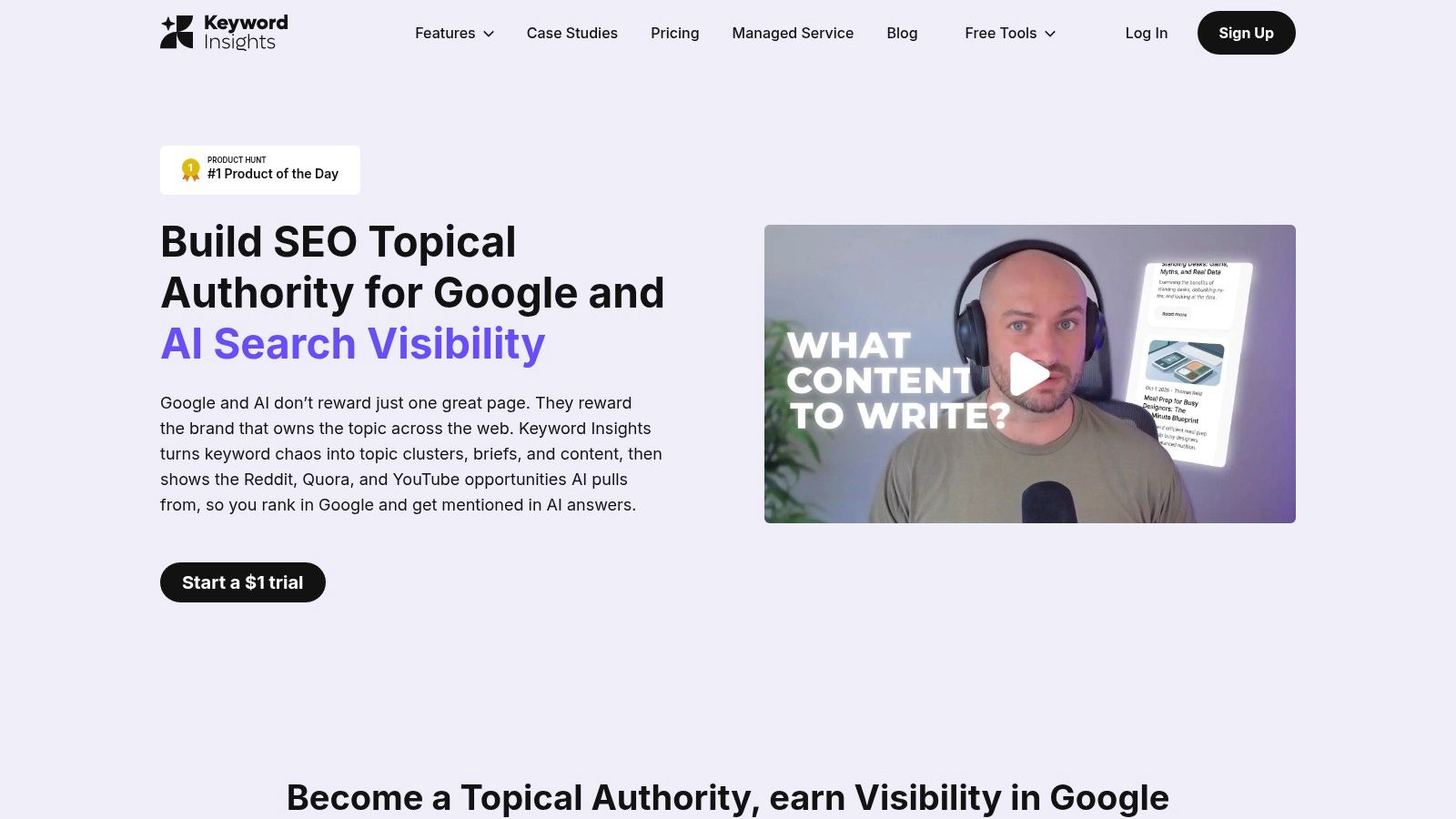
Keyword Insights pulls live, country-specific results and clusters keywords whose ranking URLs overlap, with an adjustable threshold. The product page lists support for up to 200,000 keywords per batch. Each report carries the ranking URL, average rank, intent, potential traffic, difficulty, and SERP features, and a cluster can be pushed into a content brief.
Practical rule: set the overlap threshold high for commercial pages and lower for informational clusters. The threshold is the strategy, not a setting to leave alone.
That one control is why this tool behaves differently from a semantic grouper. Raising it produces more, narrower pages. Lowering it consolidates. Neither is correct in the abstract, and the right answer changes with how much you can write and maintain.
The case for clustering at all is directional rather than guaranteed. An industry summary of a 2025 comparative analysis reports that content organized into topic clusters generated approximately 30% more organic traffic and retained rankings 2.5 times longer than standalone content in that analysis (content and SEO statistics summary). Those figures come through secondary summaries, so use them as a target, not a promise.
Cost is credit-based, and a 40,000-keyword project burns through credits fast. Scope each batch to the clusters you'll write this quarter.
6. Keyword Cupid
The mind map is the feature. Whether it's a feature or a distraction depends on whether you plan in silos.
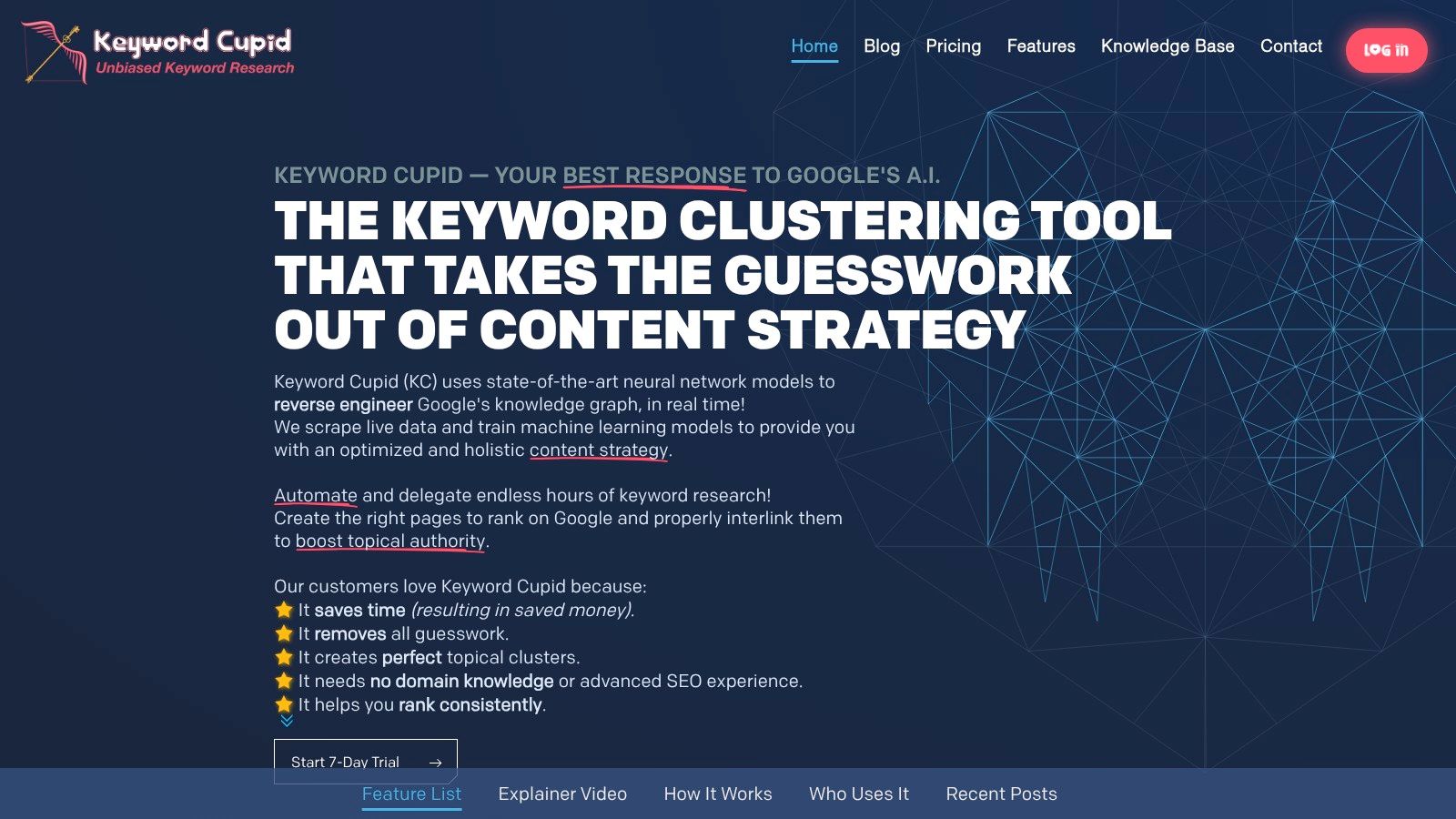
Keyword Cupid combines live SERP pulls with machine-learning grouping, then shows the result as an interactive mind map or dendrogram. Geographic, device, and search-engine targeting are supported, and you can bring your own CSV or Excel data with volume, difficulty, and CPC already attached.
Why a hierarchy beats a flat list
A flat cluster list hides the structure that makes internal linking work. The research behind hierarchical clustering predates most of these tools. Standard topic models assume every document shares one topic space, and Group Latent Dirichlet Allocation was introduced to address that forced-topic problem by combining local topics organized into groups with global topics shared across documents, as described in a study in Digital Scholarship in the Humanities.
The practical read: let a keyword belong to more than one branch, and don't force every term into a single silo just because the chart looks cleaner that way.
The downloadable Excel reports are what many teams use. The visual is for the conversation with a client who wants to see the shape of a topic before approving budget.
A subscription is hard to justify if you cluster twice a year. Live SERP reports take time to run, and accuracy depends on the input data and the results Google returns on the day.
7. thruuu Keyword Clustering
A low-commitment way to test SERP-based clustering before you buy credits anywhere.
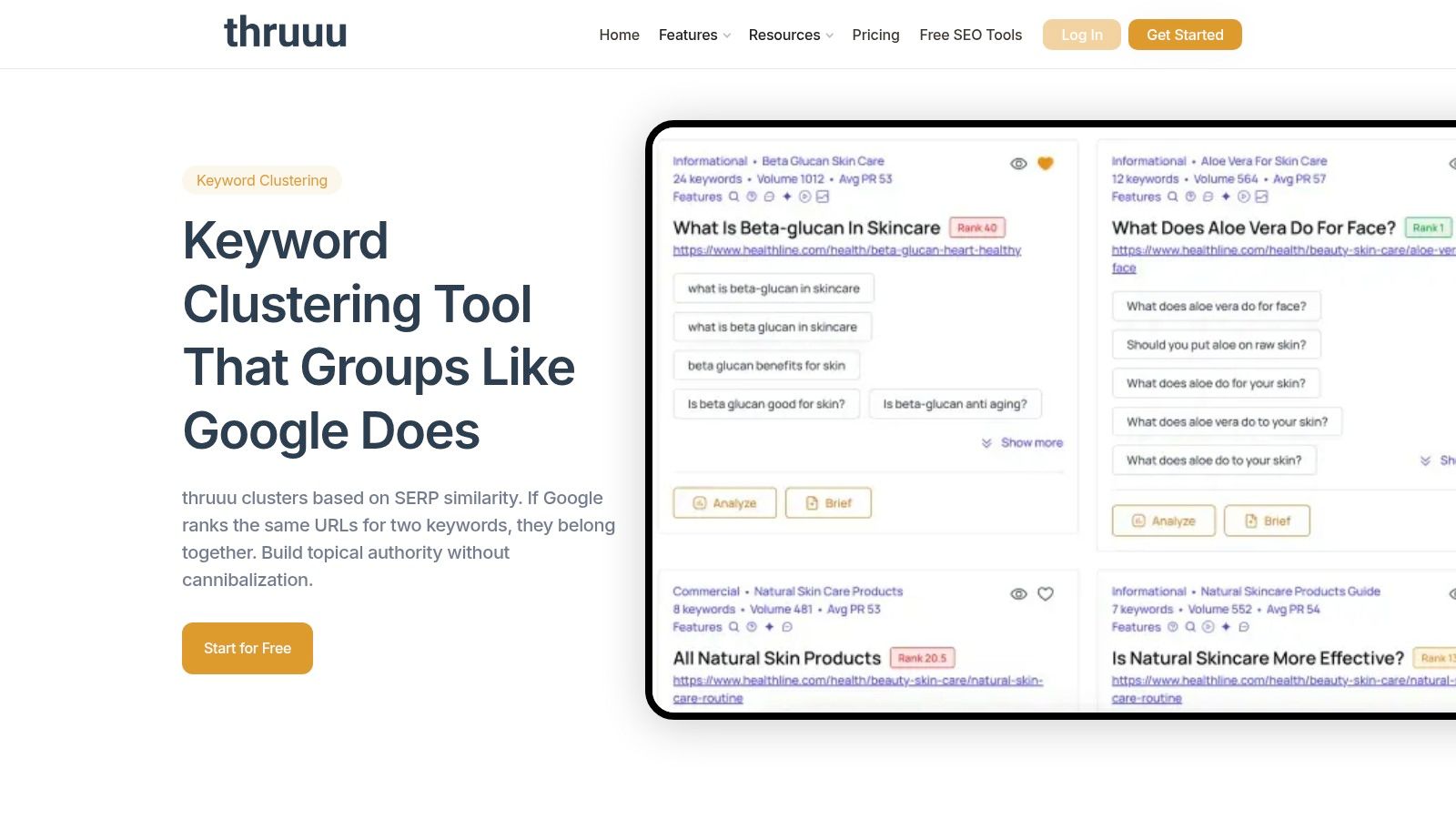
thruuu groups keywords by Google SERP overlap and gives you controls for clustering precision. Search-intent and SERP-feature insights appear on eligible plans, and a finished cluster can become a content brief without leaving the tool.
What a brief adds that a cluster doesn't
A cluster tells you which keywords belong together. A brief forces you to state the angle, the competing URLs, the format, and the questions the page has to answer. That's where the editorial decision happens, and it's the step most generators skip entirely.
Published plan details put free access at a one-time 500-keyword batch, with larger capacities and advanced features on paid plans or credits. That's enough to run the workflow on one real project before you commit.
The limit worth knowing is conceptual rather than technical. SERP overlap tells you what Google treats as one problem. It says nothing about whether your audience cares, what proof you can offer, or which cluster should ship first. Those decisions stay with you, and they're the ones that determine whether the cluster produces anything.
Country and language options sit on paid plans, which matters if you run multilingual sites and need the clustering to match the market rather than a single default.
8. Senuto Content Planner
Point it at a domain, add a few keywords and a competitor or two, and it proposes the articles to write.
Senuto's Content Planner generates article suggestions from a website, selected keywords, and optional competitor domains, groups keywords into topic clusters with silo-style planning, and adds filters, intent labels, potential traffic, content guidelines, and SERP analysis for each suggestion. Plans connect to Senuto Writer and rank tracking, and a 14-day trial runs without a credit card.
The output reads like a quarterly editorial queue. That is useful when the problem is too many candidate topics and no order; it is less useful when your team already knows the queue and only needs clustering evidence. The suggestions still need review for intent fit and whether the potential traffic justifies the page.
The trade-off is scope. Everything here is aimed at website and search content, while 50% of marketers surveyed in HubSpot's 2024 global social media marketing report planned to increase their investment in social selling (Amplitude Marketing summary). A search-only planner will not cover that demand.
Content-plan and query limits vary by tier, so check the ceiling before you build a habit around it. Treat it as a content operations decision as much as an SEO one: the constraint is what forces a real priority order.
9. MarketMuse
MarketMuse doesn't ask what you want to rank for. It asks how well you already cover a subject.
MarketMuse builds topic models that show related subtopics and their relationships, then runs cluster analysis against your existing pages to find missing coverage or pages that need work. Topic research, briefs, and strategy documents sit on paid plans. The free plan includes limited applications and 10 queries per month and leaves out briefs and strategy documents.
The audit use case beats the planning use case
Used as a planning tool, it produces long lists of subtopics. Used as an audit, it tells you which pages are thin, which are duplicating each other, and which gaps are real. The second job is where it earns its money on a library of a few hundred pages.
Coverage alone doesn't earn rankings. Google's guidance states that its ranking systems prioritize helpful, reliable, people-first content and evaluate signals tied to experience, expertise, authoritativeness, and trustworthiness (Google's guidance on creating helpful content). A subtopic you can't say anything original about is a page you shouldn't publish.
- Require a distinct intent: every node needs a job the parent page doesn't already do.
- Require evidence: first-hand experience, a test, a dataset, or a worked example.
- Require a link direction: if you can't say which page links to which, the cluster isn't finished.
That checklist is a content workflow problem more than a tooling one. MarketMuse gives you the map. The review discipline is yours to supply. Small teams regularly buy more capability than they can act on.
10. Ahrefs Keywords Explorer
Parent Topic clustering is the fastest way to find the pages you're about to duplicate.
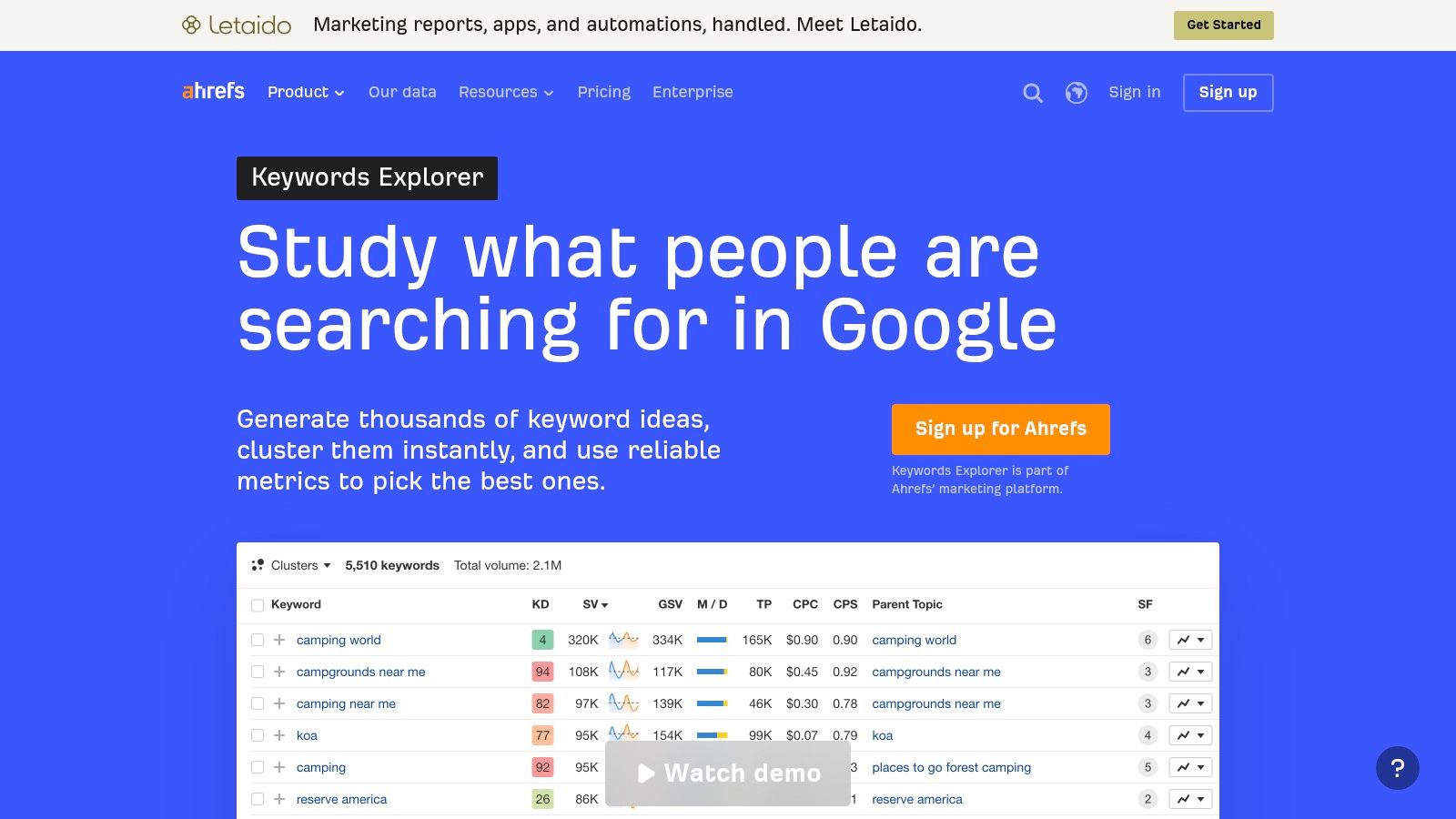
Ahrefs Keywords Explorer groups a keyword list by Parent Topic, the top-ranking page for each query, and Ahrefs describes a 10,000-keyword limit for clustering an existing list. You get search volume, keyword difficulty, traffic potential, and search intent alongside the grouping, plus competitor analysis and keyword-gap workflows in the wider platform. It requires a paid Ahrefs plan.
Faster than it is precise
Two keywords in the same Parent Topic usually belong on one page. Two keywords in different Parent Topics sometimes belong together anyway, and that's where your judgment has to override the tool.
Parent Topic is coarser than full SERP overlap. It uses one top-ranking page rather than the whole result set, so borderline terms can land in separate groups even when their results mostly match. For deciding whether two phrases need separate URLs, a dedicated overlap tool gives a sharper answer. Ahrefs is faster for a first pass across a large list.
Where it wins is context. Clustering inside the same platform that holds your competitor data, backlink profile, and rank tracking means fewer exports and fewer translation errors between tools.
Expect to interpret the output. A clean Parent Topic column can still produce a cluster where one keyword wants a listicle and the next wants a product page, and that mismatch is invisible in the table until a writer hits it.
How the ten tools differ by starting input, free access, and best use
| Item | Starting Input | Free Access | Best For |
|---|---|---|---|
| Topic Cluster Generator | Topic, sitemap, keyword list, or internal-link data | Free, no account required | Brainstorming SEO topics and mapping site architecture |
| Keyword Clusters | Pasted keywords or SEO-tool exports | Free, no account required | Grouping existing keyword lists in the browser |
| SEOcluster.ai | Google Search Console queries | Free tier: one site, 1,500 keywords per dataset, three runs monthly | Improving existing SEO pages using site query data |
| Semrush Keyword Strategy Builder | Up to five seed keywords | Paid SEO Toolkit subscription required | Building metric-informed pillar and subpage plans |
| Keyword Insights | Keyword lists | Trial available; ongoing use is paid and credit-based | Large-scale, SERP-based keyword clustering |
| Keyword Cupid | Keywords or CSV/Excel reports | Subscription-based; no free access specified | Visualizing hierarchical clusters and SEO silos |
| thruuu Keyword Clustering | Keywords for Google SERP-overlap analysis | One-time batch of up to 500 keywords | Trying SERP-based clustering and connecting clusters to briefs |
| Senuto Content Planner | Domain, selected keywords, and optional competitor sites | 14-day trial advertised, no credit card required | Creating SEO article plans and topic clusters |
| MarketMuse | Focus topic or existing content library | Free plan with limited applications and 10 queries monthly | Assessing topical coverage and planning content |
| Ahrefs Keywords Explorer | Seed topics or an existing keyword list | Paid Ahrefs platform required | Combining keyword clustering with SEO metrics and competitor research |
Match the Tool to Your Input, Then Check the Output
Start with what you already have rather than with a feature list. A blank topic points to a generator that proposes structure. A keyword export points to clustering, and the choice between semantic and SERP-based grouping is the key decision. A Search Console property points to a site-specific tool that reads what you already rank for. An existing library points to an audit before it points to a plan.
Whichever you choose, verify before you plan pages. If a tool hands you 60 clusters, you don't have 60 pages. You have 60 hypotheses, and most of them will collapse under a live results check.
- Run the search: read the actual results page for two or three keywords from every cluster you intend to keep.
- Check for overlap: if two clusters would produce pages answering the same question, merge them and add the terms to one URL.
- Assign an owner: a cluster with no named owner stops being maintained within a quarter.
Then measure at the cluster level rather than page by page. Impressions, clicks, ranking keywords, assisted conversions, internal-link engagement, and the share of supporting pages that send traffic to the pillar tell you whether the architecture works. So does time-to-publish and editorial acceptance rate, because a cluster that performs but requires weeks of restructuring isn't improving your operation.
If your clusters need to become LinkedIn posts, PostPilot is a LinkedIn content agent that moves from ideas to planning and scheduling. Its demo can be explored without an account, email address, or LinkedIn connection, and the examples show the intended workflow rather than live publishing.
The tools in this list give you a map. The decision about which clusters deserve a page, an angle, and an owner stays with the person who knows the subject.
PostToGo applies the same input-first logic to LinkedIn content. You bring the expertise you already have, and the PostPilot workflow shapes it into topics, angles, and a posting calendar you can review before anything goes out. Visit PostToGo to explore the demo and see how a topic cluster becomes a posting plan.