Topic Cluster Model Explained: Pillars, Links and Examples
Learn how the topic cluster model links one pillar page to supporting pages, with build steps, examples and rules for merging or expanding content.
Open your blog archive and scroll. Sixty posts, three years, and no visible order. One explains a pricing question a customer asked last spring. Another reviews a tool you tried once. Between them sit dozens more that share a vague family resemblance and nothing else: no links, no shared theme, no path from one page to the next.
That archive isn't a failure of effort. It's a failure of architecture, and it's the most common one in small business publishing. The fix has a name, and it's simpler than the acronyms around it suggest. It's also a structure that needs tending long after you build it, which is the part most guides skip.
Table of Contents
- Why Scattered Blog Posts Stop Working
- The Pillar and Cluster Structure Explained
- How Internal Links Tie a Cluster Together
- How to Build a Topic Cluster Step by Step
- A Worked Example for a LinkedIn Business
- Deciding When to Merge, Expand or Drop Pages
- Map Your First Cluster Before Your Next Post
Why Scattered Blog Posts Stop Working
Picture the reader's path. Someone searches a question, lands on post 37 of your archive, reads it, and leaves. There's no second page to visit because post 37 links nowhere, and nothing links to it. The visit ends where it started.
Now picture the crawler's path. Googlebot fetches the same page, follows whatever links it finds, and comes up empty. Sixty posts about six different subjects look to a search engine like sixty unrelated pages. Nothing on the site tells the machine that you know one subject, because nothing on the site says so.
The topic cluster model fixes that with a single organising idea. One central pillar page covers a broad theme at a high level. A set of cluster pages each answers one narrower question inside that theme. Internal links connect the pages so readers and crawlers can move between them.
Think of a library. A good one groups books by subject, labels the shelves, and puts a signpost where one subject touches another. A warehouse holds the same books in unlabelled boxes, and nobody finds anything.
The test: if a reader can't get from the post they landed on to a second related post without going back to Google, you've built a warehouse.
Those sixty scattered posts aren't wasted work. They're raw material for one or two clusters. Before reading further, ask yourself which three or four of them share a theme strong enough to anchor a pillar.
The Pillar and Cluster Structure Explained
Sketch it as a wheel. The pillar sits at the hub, and cluster pages radiate outward like spokes. Every spoke touches the hub, and a few touch each other where the subjects genuinely overlap.
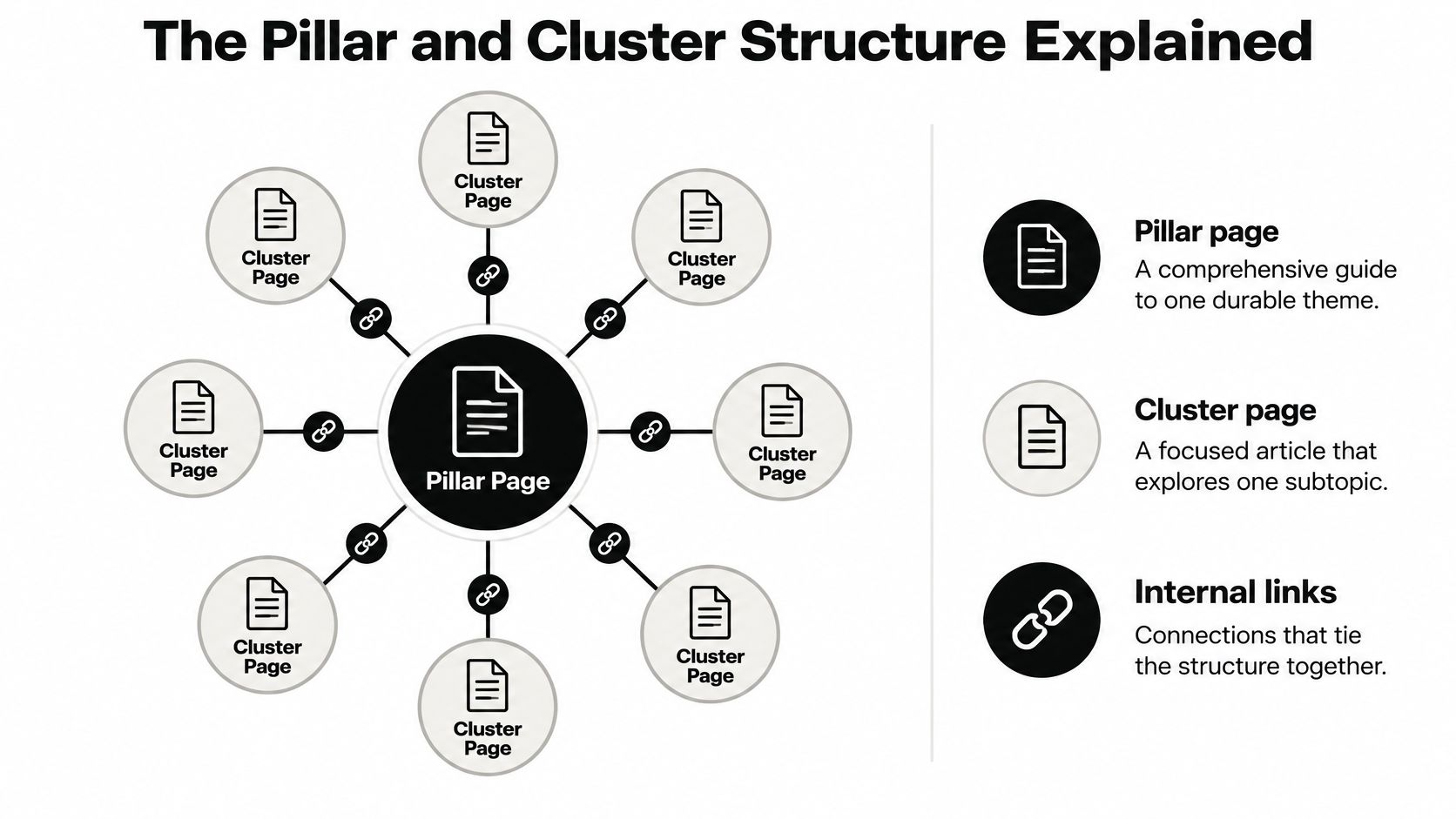
The pillar is a guide, not an encyclopedia. It covers breadth: every major subtopic gets a definition, a short explanation, and a link to the page that goes deeper. It should stand on its own as a useful answer for someone who searched the broad term.
Each cluster page owns one question. A specific how-to, a use case, an audience problem, a comparison. One page, one intent, answered properly and at length, then linked back to the hub.
| Component | What it covers | Typical length | Link pattern |
|---|---|---|---|
| Pillar page | A broad guide to one core theme, covering every subtopic at a high level | The longest page in the cluster, built for breadth | Links out to every cluster page |
| Cluster page | One narrow subtopic, question or use case | Shorter than the pillar, deep on one question | Links back to the pillar and to related clusters |
| Contextual internal link | Anchor text inside a sentence that joins two related pages | One or two sentences of surrounding text | Shows readers and crawlers a path between pages |
| Orphan page | A page with no internal links pointing to it | Any length | Needs at least one link from another page on the site |
Linking runs in both directions and it isn't decorative. The pillar links out to every cluster page, ideally in the section where that subtopic comes up. Each cluster links back. Related clusters cross-link where the reference reads naturally to a person reading the sentence.
The failure mode to watch for
An orphan page has no internal links pointing at it. It might pick up a ranking by accident, but it will never carry its weight in a cluster, because neither readers nor crawlers have a route to it.
The structure itself follows a decade of change in how search engines read pages. Google's Hummingbird update in 2013 began interpreting the meaning of complete search phrases rather than individual keywords, and RankBrain in 2015 applied machine learning to query context and related concepts. HubSpot researchers Anum Hussain and Cambria Davies ran topic-cluster experiments in 2016, published in the Topic Clusters SEO report, and the model was widely documented by 2017. The architecture works because it matches how modern search systems interpret entities and related questions, not because someone declared it a best practice.
The awkward-jump test
Before you commission a page, try writing the sentence that would link it from the pillar. If that sentence needs a detour into a different subject, the page belongs to another theme. A cluster held together by strained transitions is two clusters wearing one coat.
How Internal Links Tie a Cluster Together
A cluster is only a cluster because of its links. Pages about the same subject that never point at each other are a coincidence, not a structure.
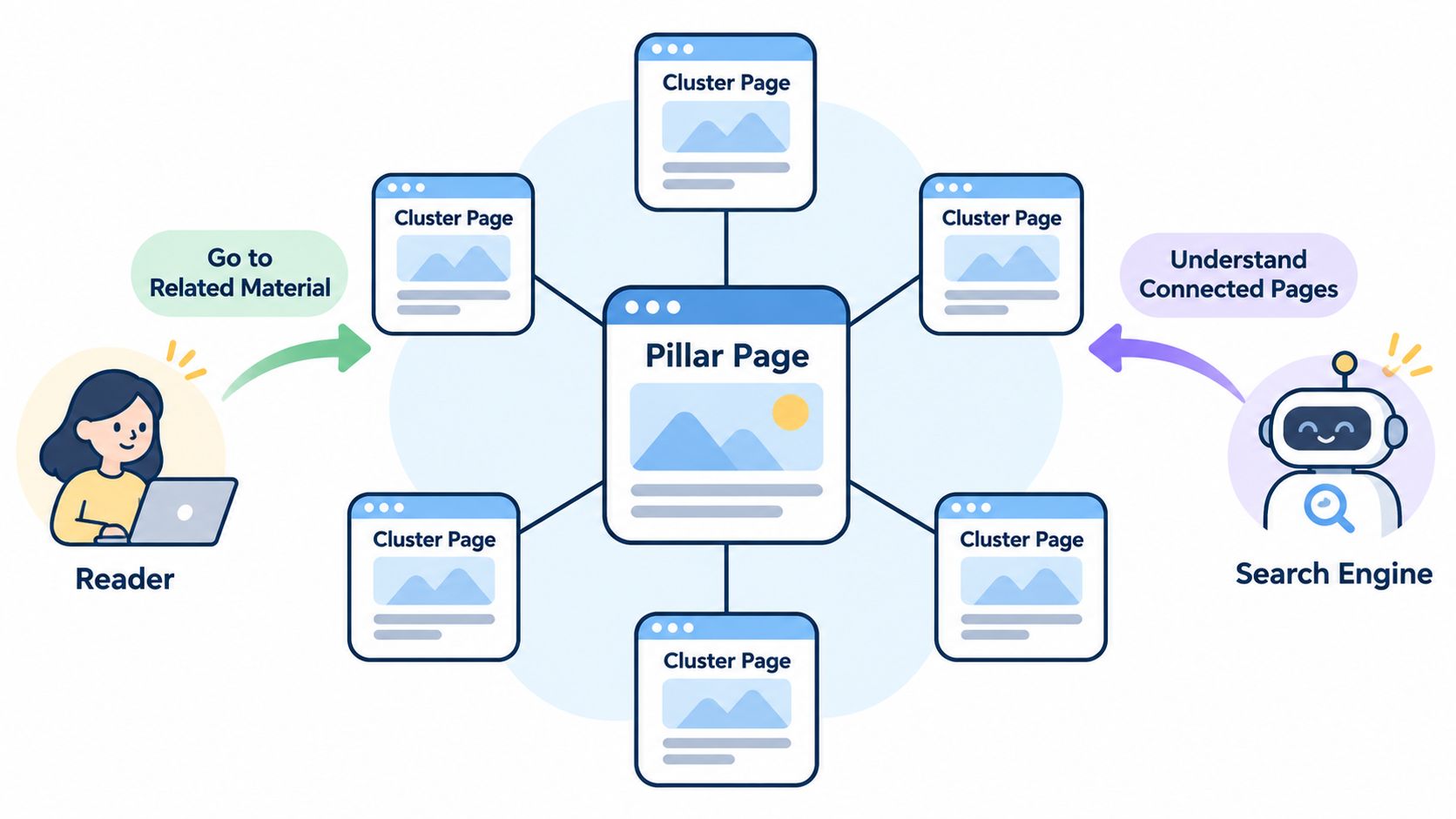
A link does two jobs at once. It gives a reader a route to the next useful page, and it tells a search engine how two pages relate and where to look for more. Google's guidance on crawlable links is direct about this: links help Google determine page relevance and find new pages to crawl, and every important page should have at least one internal link from another page on the same site. The same documentation describes intuitive internal-link architecture as important for indexing and for navigation.
The road-network analogy
Two towns joined by a well-signposted road behave differently from two towns joined by a track nobody uses. The road matters because traffic travels it, and the signage matters because it tells drivers where they'll end up. An internal link works the same way. Its value comes from being clear and from being used.
Anchor text is the sign
Write link text so it describes the destination. "How to write a first line that earns a reply" does more work than "click here" or "read more", because the words themselves tell the crawler and the reader what sits on the other side.
Two slips undo the effort. The first is linking everything to everything, which flattens the hierarchy until no page looks more important than any other. The second is relying on the navigation menu for all internal linking.
Practical rule: link from inside a sentence, right where the subject comes up, and use the destination's own language as the anchor.
A five-minute audit
Pick one cluster page. Any one in your best-developed theme.
Count the pages that link to it. Search your CMS for the URL, or run a free crawl and check the inbound internal links.
Inspect the anchor text. If the only inbound link sits in the footer or the menu, you've found a fix worth making today.
Follow the shortest path back. The pillar should be one hop away, not three.
How to Build a Topic Cluster Step by Step
The build runs in a fixed order, and most of the trouble comes from doing the steps out of sequence. Here's the sequence, with the mistake that tends to show up at each stage.
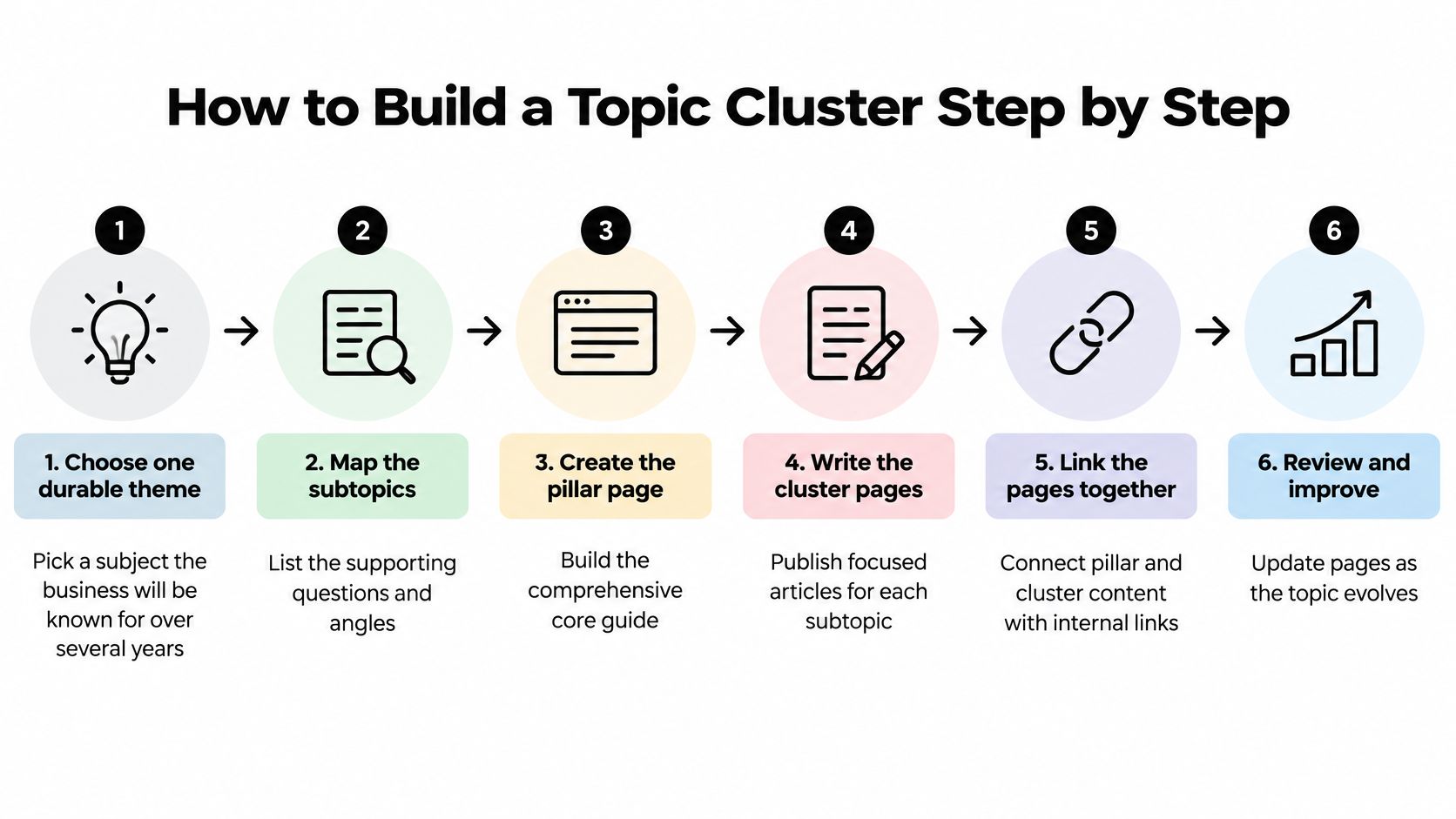
1. Choose one durable theme. Pick a subject the business will still be known for in three years. "LinkedIn content for small professional services firms" is durable. "The algorithm change everyone is posting about this month" isn't, and it makes a poor hub because nothing sits underneath it.
The common slip is choosing the theme with the highest search volume instead of the theme the business can speak about with earned authority.
2. Map the subtopics. List the questions the audience asks, drawn from customer emails, sales-call notes, comments and support tickets. Group them until patterns appear. Five to ten distinct questions make a workable cluster.
Jumping straight to a keyword tool is the usual mistake here. A keyword tool tells you what people type. Your inbox tells you what confuses them, which is the better brief.
3. Write the pillar first. Cover every subtopic at a definition-and-framework level, and name each cluster page you intend to link to. Writing the hub first forces you to fix the cluster's scope before you've spent months on spokes.
The slip: publishing cluster pages one at a time because they're quicker, then never writing the page that gives them meaning.
4. Score each candidate cluster page. Rate it against three things: closeness to the pillar, whether it answers a different question from its neighbours, and whether you have real experience to add, such as a project lesson or a measured result.
Research behind topical clustering earns its keep. Google researchers modelled topical clustering of search results as graph clustering, with topics as nodes and semantic relatedness as edges, and reported relative improvements of up to 20% over comparison systems in Topical Clustering of Search Results. The lesson for a small team is blunt: build spokes around meaning, not around a shared keyword.
5. Publish in order of demand. Start with the cluster page your audience needs most, and add the link from the pillar and the link back on the day it goes live. Two published pages with four links beat ten drafts.
Publishing a spoke and forgetting the inbound link from the hub is the mistake to avoid. A page without a link is an orphan by lunchtime.
6. Review the map every quarter. Check for gaps, duplicates, and pages nothing points to. Cluster work is maintenance, and the next section handles the decisions that come up during that review.
A finished cluster is usually modest: one pillar, somewhere around five to ten cluster pages, and no page a reader can't reach from the hub. If this is your first time, the walkthrough below shows the structure in motion before you commit an afternoon to it.
A Worked Example for a LinkedIn Business
Say a two-person consultancy helps founders write LinkedIn posts. Clients ask the same handful of questions in slightly different words, and the team has answered them in DMs for two years. That message history is the cluster plan.
Their pillar is a guide to building a consistent LinkedIn presence for a small business: why consistency beats intensity, what a weekly routine looks like, how to source ideas, how to write openers, how to read results. Each major section of the pillar points to one cluster page.
| Page type | Topic | Intent answered | Links to |
|---|---|---|---|
| Pillar | LinkedIn content for small businesses | How to build a consistent presence | All cluster pages |
| Cluster | Writing hooks that earn replies | How to write a strong first line | Pillar and posting rhythm |
| Cluster | Turning client questions into posts | Where to find post ideas | Pillar and hooks |
| Cluster | Weekly posting rhythm | How often to post and when | Pillar and post ideas |
| Cluster | Measuring impressions and comments | Which posts worked and why | Pillar and hooks |
The choice that mattered
The team drafted a second hooks article, a list of forty openers, and deleted it. Both pages would have answered the same intent, so the pair would have split signals between two URLs and left the reader choosing between them. One strong page beats two compatible ones.
The tightest link in that cluster runs between hooks and post ideas, because a founder who can't find material rarely writes a sharp opener anyway. That's a contextual link placed where the reader needs it, not a menu item.
Two tests to apply to your own cluster
Can a reader reach every page from the pillar in two clicks? If a spoke needs three hops, the pillar's sections need reorganising, not more links.
Does each page stand alone? Someone landing on the measuring page from a search result should get a complete answer without reading the other three.
Neither test needs paid software. Both catch most of what goes wrong.
Deciding When to Merge, Expand or Drop Pages
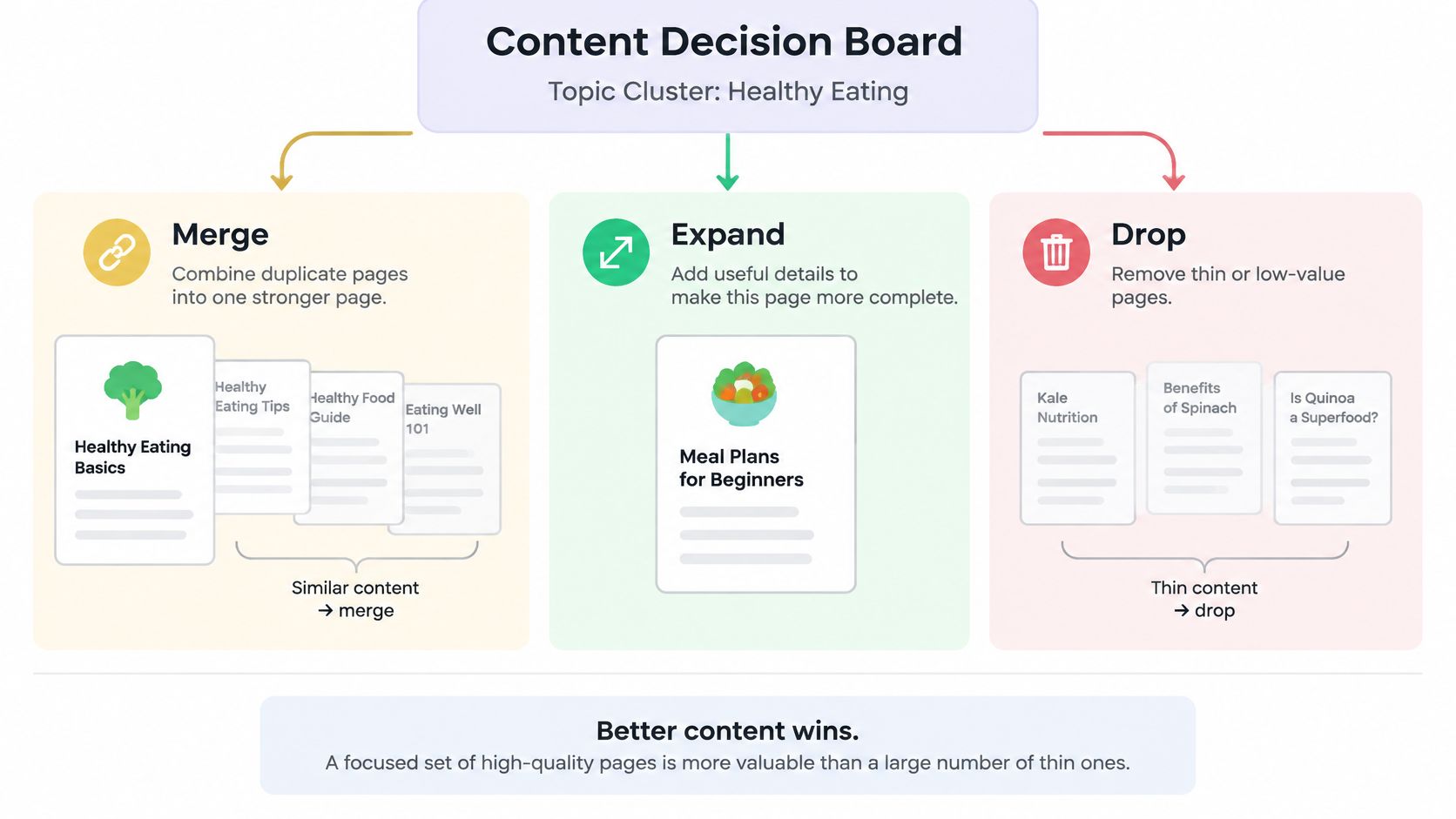
More cluster pages do not make a stronger cluster. Past a certain point they make it weaker, because thin pages answering near-identical questions compete with each other and blur what the site stands for.
Rankpedia's guide to topic clusters makes that case plainly: a smaller set of distinctive pages can outperform a large collection of thin articles when each page has a defensible purpose and measurable audience value. The same guidance recommends giving every URL one clear search intent, resolving overlapping pages, and consolidating weak duplicates before anyone writes another word. Building is additive work. Pruning is editorial work, and it's the half that gets skipped.
Two checks before you write anything new
Assign one intent per URL. Write down, in a single sentence, the question each page answers. If two sentences match, merge the weaker page into the stronger one rather than publishing a third.
Read the signals you already have. Impressions, backlinks, conversions and near-page-one rankings show where the cluster is close to working. A page sitting on page two with steady impressions usually needs a sharper title and opening, not a sibling.
| Signal | What it suggests | Action |
|---|---|---|
| Two pages rank for the same query | Duplicate intent | Merge into the stronger URL |
| High impressions, low clicks | Title or intro does not match the intent | Rewrite the title and opening |
| No internal links pointing to the page | Orphan page | Link from the pillar and one related cluster |
| Page drives comments, leads or conversions | Real audience demand | Expand with a new, distinct subtopic |
| Thin page with no traffic after several months | Weak purpose | Consolidate into a related page or retire it |
What makes a page worth citing
Answer engines have changed the calculation. Search Engine Land's topic cluster guide reports that current workflows audit pages for AI Overview coverage, prioritise high-impression, low-click queries, and map content to conversational questions and answer surfaces. That guidance is procedural, and it doesn't establish that broad topical coverage on its own produces citations.
The practical read is unflattering for volume publishing. A page that restates a common summary gives an answer engine no reason to pick it over the next summary. A page with a first-hand example, a measured outcome, or a firmly held opinion gives it one.
Rule of thumb: commission a new spoke only when it adds evidence the cluster doesn't already contain. If the page would repeat what the pillar and two spokes already say, it's a rewrite dressed up as growth.
Around four to six spokes is often where a small business cluster stops improving and starts diluting. Watch the signals, not the page count.
Map Your First Cluster Before Your Next Post
Three things to do this week, before you write another post.
Write the pillar outline. Pick one durable theme, then list every subtopic the pillar will introduce. Eight to twelve headings is a workable shape for a first pass. That outline is your map; the prose comes later.
Collect ten real questions. Pull them from customer emails, call notes, comments and the questions you answer on repeat. Sort them into cluster candidates, then score each one for distinctness and for the experience only you can bring to it.
Schedule two cluster pages and their links. Two proves the structure. Publish each with a link from the pillar and a link back, then check both from a reader's point of view.
PostToGo's PostPilot is built for that planning step: it brings topics together in a content plan that makes the next step clear, and it shows planned posting times on a content calendar. Its suggestions are starting points to adapt with your own knowledge and editorial judgment, not finished posts.
One question to answer before you publish again: which cluster page does this post belong to, and which pillar will link to it? If you can't name the pillar, you've found the gap worth fixing first.