Marketing Team for Small Business: Roles That Work
Learn how to structure a marketing team for small business: who owns what, how to pick a staffing model, and a weekly workflow that fits a tight budget.

Only 16% of small-business leaders are very confident they're using the right marketing channels, even though 82% agree that multi-channel campaigns produce better results. Both figures come from a global survey of 1,335 businesses with fewer than 250 employees conducted for Found. Put them side by side and you get the situation inside most small firms: plenty of activity, and not much confidence that the activity is pointed at the right target.
A marketing team for small business rarely looks like the department the name suggests. It's usually an owner with a notebook, a part-time generalist who also handles invoices, and maybe a freelancer paid by the post. The constraint that shapes everything isn't headcount on an org chart. It's the owner's attention and editorial judgment, the one input nobody can outsource without losing the thing that makes the content worth reading.
So treat this as a design problem rather than a hiring problem: which jobs exist, who owns each one, how work moves between people, and how you find out whether any of it paid off before you add more output.
Table of Contents
- Why Small Businesses Rarely Build a Marketing Department
- Five Staffing Models and Who Each One Suits
- Who Owns Each Job and What the Owner Keeps
- How to Run a Weekly Workflow From Expertise to Scheduled Post
- Briefing Freelancers and Handing Off Work
- Coordination Problems and How to Fix Them
- Measuring Whether the Team Pays Off
- Start With One Structure This Month
Why Small Businesses Rarely Build a Marketing Department
A three-person bakery doesn't hire a pastry department. The owner bakes, works the counter, orders flour, and does the books. Marketing happens after the last loaf is sold, which in a good week means a photo and a post.
That instinct is backed by numbers. A 2024 compilation of small-business marketing research from LocaliQ reports that only 21% of small businesses employ marketing teams with five or more people. The same compilation finds that businesses with 10 or fewer employees are 31% more likely to run a marketing budget below $500 a month, and that roughly 15% of marketing spend goes to social media.
Read those two figures together and the shape of the problem appears: limited headcount and limited recurring funds at the same time. Marketing gets spread across the owner, a generalist employee, a freelancer, or a small specialist group, and none of those people does marketing as their only job.
The arrangement looks efficient on paper. In practice it carries three costs that never show up on a budget line.
- The switching cost: every time the owner stops selling to write a post, the business pays for the context switch, not just the writing time. Twenty minutes of drafting after an eight-hour day produces weak drafts.
- The notebook problem: the best material, meaning customer objections, fixes, and hard-won lessons, sits in the owner's head or a notes app and never becomes a post, because turning it into one is a separate job nobody owns.
- The rhythm collapse: posting runs for three weeks and stops in week four, when a delivery is late or a big quote lands. Restarting costs more than continuing, because the audience has stopped expecting anything.
A marketing team in this context means a defined set of people with named responsibilities, even when one person holds three of them. Before you pick a structure, list every marketing task currently happening in the business and write down who performs each one, including the ones that happen irregularly. The gaps you find are usually not the ones the owner expected.
Five Staffing Models and Who Each One Suits
| Model | Who executes the work | Owner hours per week | Best fit | Main risk |
|---|---|---|---|---|
| Owner-only with a scheduled block | Owner writes and posts | 3-5 | Founder with strong expertise and a steady routine | Stops during busy weeks |
| Owner plus generalist employee | Employee drafts, owner approves | 2-4 | Business with a steady sales cycle and a team member who can write | Owner review becomes the bottleneck |
| Owner plus freelancer | Freelancer drafts and schedules, owner supplies expertise | 2-3 | Business that can supply regular input each month | Quality drops without a briefing system |
| Fractional marketer | Part-time specialist runs the plan, owner approves | 1-2 | Business needing strategy and outside oversight | Specialist lacks insider detail |
| Two to four person in-house team | Dedicated roles for content, distribution and analysis | 1-2 | Multi-location or high-volume business | Overhead and coordination cost |
Read the table by column, not by row. The owner hours column is the deciding one, because it measures the input the whole system runs on. The model column comes second and the budget comes third.
Decision rule: pick the model by the hours the owner can genuinely give each week, not by what looks affordable this quarter. A cheap model the owner can't feed with expertise stalls inside a month.
Budget rarely sets the constraint on its own. In 2024, 63% of small businesses planned to increase their marketing budget during the following year, according to SimpleTexting's small-business marketing statistics. More money spent without more owner attention just buys unused capacity, or content so generic it could belong to any competitor.
Channel breadth creates the same trap. The Verizon 2024 Small Business Survey found that 84% of decision-makers used Facebook to promote products and connect with customers, 67% used Instagram, and 54% used LinkedIn alongside several other networks. Five channels on one pair of hands is not a strategy. It's a schedule with holes in it.
Most firms sit in the first three rows, which is why the next sections spend their time on workflow rather than on hiring plans. A simple test settles the choice: count the owner's realistic weekly hours for four consecutive weeks, not the ideal number, then select the lowest-cost model that still covers both review and scheduling.
Who Owns Each Job and What the Owner Keeps
A team is defined by the jobs it covers, not by the number of people on it. Four jobs have to happen every week whether or not anyone carries a title for them.
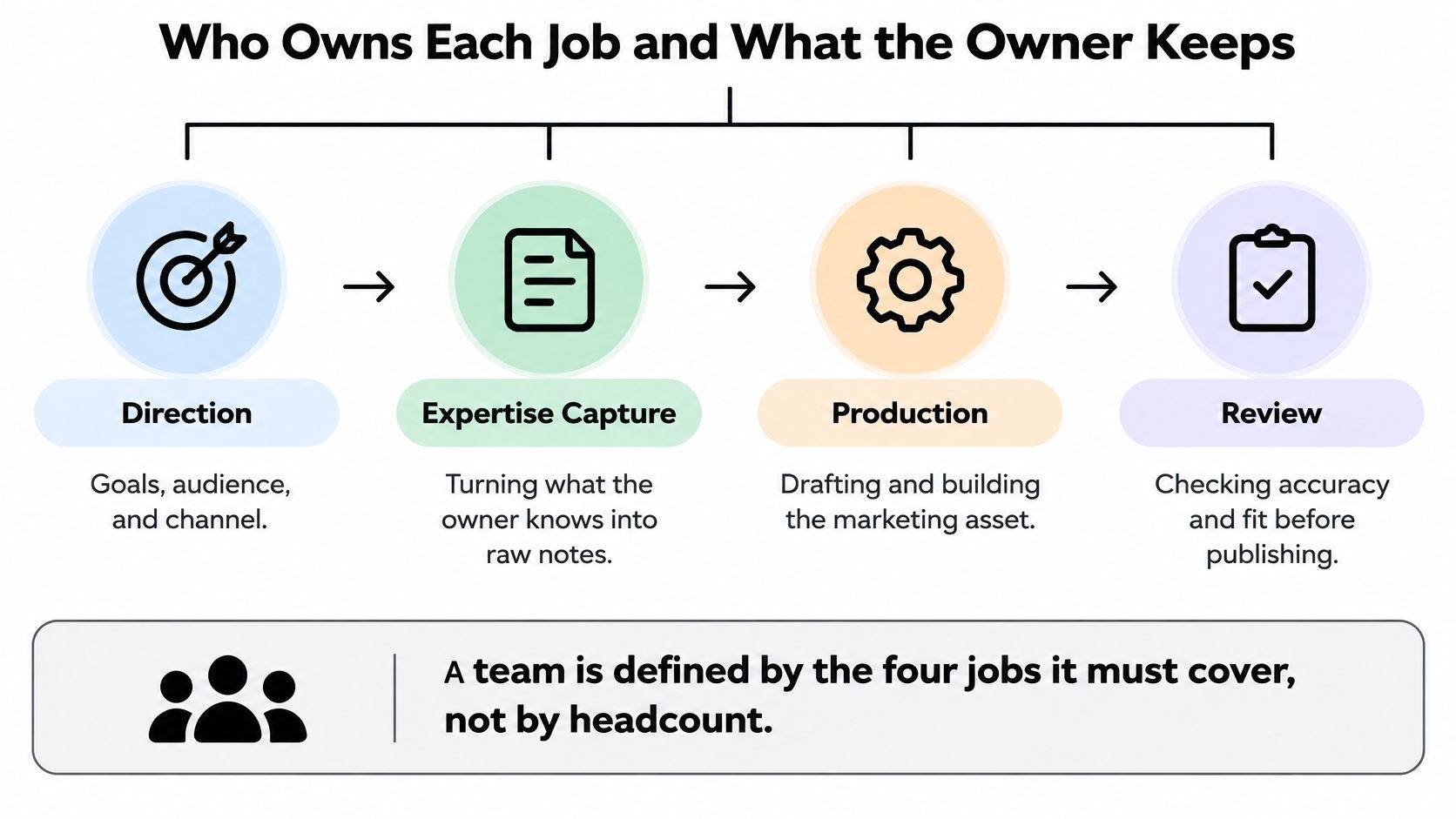
The Four Jobs a Marketing Team Must Cover
- Direction: who the content is for, what it should achieve, and which channel carries it. Usually an hour of the owner's thinking per quarter, not per week.
- Expertise capture: turning what the owner knows into raw notes with real examples, names of problems, and the wording customers use.
- Production and review: drafting, editing, checking every claim, and matching the business's voice. Most generic posts originate here, as the owner's notes often get replaced by filler.
- Publishing and analysis: scheduling posts on fixed days, then reading what happened and writing it down.
Think of a restaurant kitchen. One cook can work several stations, but each station needs a named person or dishes leave the pass late and wrong. The same applies to a three-person accounting firm, where the partner supplies the expertise, a freelancer drafts, and an assistant schedules. A solo consultant covers all four jobs, spaced across a weekly calendar so none of them gets skipped.
Where the Owner's Hours Actually Go
Recent survey work on small-business marketing capacity finds that 60% of small and midsize businesses spend just 1 to 10 hours weekly on marketing, rising to 72% among businesses with 10 or fewer employees, according to LocaliQ's small-business marketing trends report. In the same body of evidence, 62% identify limited staff as their biggest constraint, and 73% report using AI in marketing.
That last figure is the interesting one. AI adds idea volume. It doesn't add judgment, and judgment is the part that's scarce in a business with ten hours a week to spend. A tool that produces thirty post ideas in a minute has solved the problem the owner never had.
The test: if a weak answer would embarrass the business in front of a client, the owner reviews it. If it wouldn't, it can move.
What stays with the owner: positioning claims, final approval of anything public, the customer stories only they can tell, and decisions about what the business won't say. What moves: drafting from notes, formatting, scheduling, and reporting. That split is how the PostPilot demo is designed to be used, with suggestions presented as inspiration to shape rather than a replacement for the user's knowledge or editorial judgment.
A plumbing owner records a 20-minute voice note each week. A contractor turns it into three drafts. The owner approves them in ten minutes, correcting one claim about pipe sizes and rewording an opening line. Once those notes start repeating themes, a topic cluster strategy keeps the backlog from turning into a list of unrelated one-offs.
Finish by writing one name beside each of the four jobs. If the same name appears four times, that's not a failure. It's an honest starting point, and it tells you which of the four is most likely to be dropped in a busy week.
How to Run a Weekly Workflow From Expertise to Scheduled Post
Staffing in small businesses is mixed by necessity, not by design. In a survey of more than 1,000 small-business owners and decision-makers from Campaign Monitor, 56.9% reported having dedicated in-house marketers, 20.8% had employees doing marketing alongside other responsibilities, and 15.3% relied on the owner to execute all marketing. The same survey found social media ranked first for brand-awareness activity, ahead of email, content marketing, and paid media.
That mix creates a capacity bottleneck, and the fix is a lightweight workflow with explicit ownership at four technical stages: input collection, editorial approval, scheduling, and performance analysis.
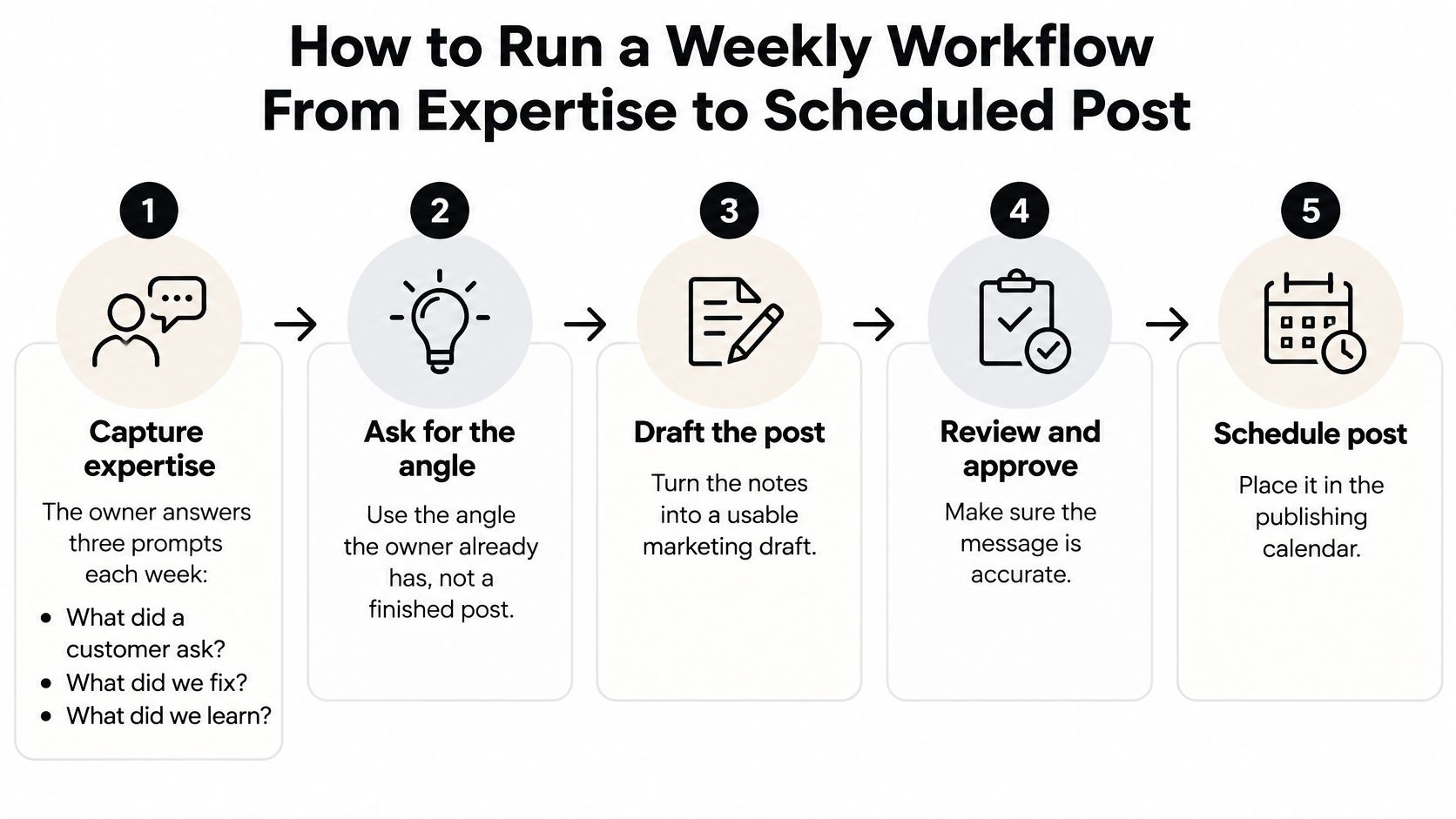
1. Capture expertise with three prompts. The owner answers the same three questions every week: what did a customer ask, what did we fix, and what did we learn. Ask for the angle they already have, not a finished post. This is the step where PostPilot's Find your angle stage fits, taking what someone knows, does, and gets asked and turning it into a fresh take on it.
2. Build a backlog of themes. Group the notes into themes, one theme per week, and never hold more than four weeks of ideas. A backlog longer than a month becomes a graveyard of stale references, and it stops the team from responding to anything current. Planning tools earn their keep here by pulling individual topics into a content plan that makes the next step obvious.
3. Draft from the notes. The contractor or employee writes from the owner's notes and keeps the owner's examples and phrasing. The moment a draft invents an example, it becomes something the owner has to fact-check from scratch, which doubles their review time.
4. Edit and approve within a fixed window. The owner reviews and checks every factual claim. Set the window in advance, because an approval that waits for a quiet afternoon waits a week.
5. Schedule on fixed days. Place each approved post on a calendar with a set day and time. A publishing calendar template makes the rhythm visible to everyone, which is the point: the schedule is a commitment device, not a filing cabinet. Scheduling inside PostPilot works the same way, letting a user plan when content goes out and see it on a content calendar.
6. Review every Friday. Check reach and conversations for each theme, not for each post. Fifteen minutes, same time each week.
Here's the workflow walked through end to end.
Write one name next to each of the four stages on a shared sheet. Any stage with no name is a gap to close before the next week starts, because unbudgeted stages don't fail loudly. They just stop happening.
Briefing Freelancers and Handing Off Work
Every transfer between owner, contractor and approver needs a written brief. Handoff rules are what stop a working weekly workflow from stalling in week six.
1. The brief names five things: the theme, the audience problem it addresses, three example stories from the owner, the publish date, and the person approving. Three example stories is the minimum that stops a contractor from filling gaps with industry-standard phrasing.
2. The contractor returns a draft inside an agreed window. Three working days from receiving the brief is realistic for a short post and generous enough to survive a busy Tuesday.
3. The owner approves or returns the draft with one line of feedback within 48 hours. One line forces a decision. A paragraph of notes usually means the brief was thin.
4. Scheduling starts only after the approval is logged on the shared sheet. Posts that jump the queue are how unverified claims reach the public.
Service levels to write beside each handoff: draft due three working days after brief, owner response within 48 hours, publish date fixed at briefing. Three numbers, visible to everyone.
Keep the freelancer's scope narrow: drafting and formatting. Claim verification and final sign-off stay with the owner. Without a brief, contractors write generic posts and owners end up rewriting whole drafts, which costs more than writing from scratch.
Coordination Problems and How to Fix Them
The most common failure in a small marketing team isn't a lack of ideas or effort. It's a post that was finished on Thursday and never went out, because nobody was sure who was allowed to press publish.
Most breakdowns trace back to one of two missing pieces: an owner for the step, or input for the person doing it. The table works as a diagnosis.
| Symptom | Likely cause | Fix |
|---|---|---|
| Posts go out late or not at all | No named owner for approval | Name a single approver and log the approval where everyone can see it |
| Posts sound generic | Contractor writes without owner notes | Require three example stories from the owner for each theme |
| Approvals wait a week | Owner reviews in batches on Fridays | Set two fixed review days each week |
| Backlog keeps growing | Too many themes and no retirement rule | Cap the backlog at a month of themes and drop stale ideas |
| Nobody knows which post worked | No tagging by theme or link | Tag each post with its theme and a tracked link |
| Team argues over tone | No shared brief | Keep a one-page voice brief updated monthly |
Notice how few of these fixes involve new tools. Four of the six are decisions about ownership or input, which cost nothing and take an afternoon to put in place. A content workflow diagram on the shared sheet prevents the same conversation from recurring every quarter.
Fix one row at a time. Change the approver rule, then watch for two weeks to see whether late posts stop. If you change three things in the same week, you learn nothing about which one worked, and you'll usually keep the wrong two.
Measuring Whether the Team Pays Off
Advice to "post consistently" is easy to give and hard to defend when someone asks what the posting produced. The evidence points to a measurement gap rather than an output gap: according to Design Loud's state of small business marketing report, only 31% of small businesses analyze marketing data monthly, and 44% struggle to measure marketing ROI. Yet among the businesses that do analyze data monthly, 67% report better decision-making and campaign performance.
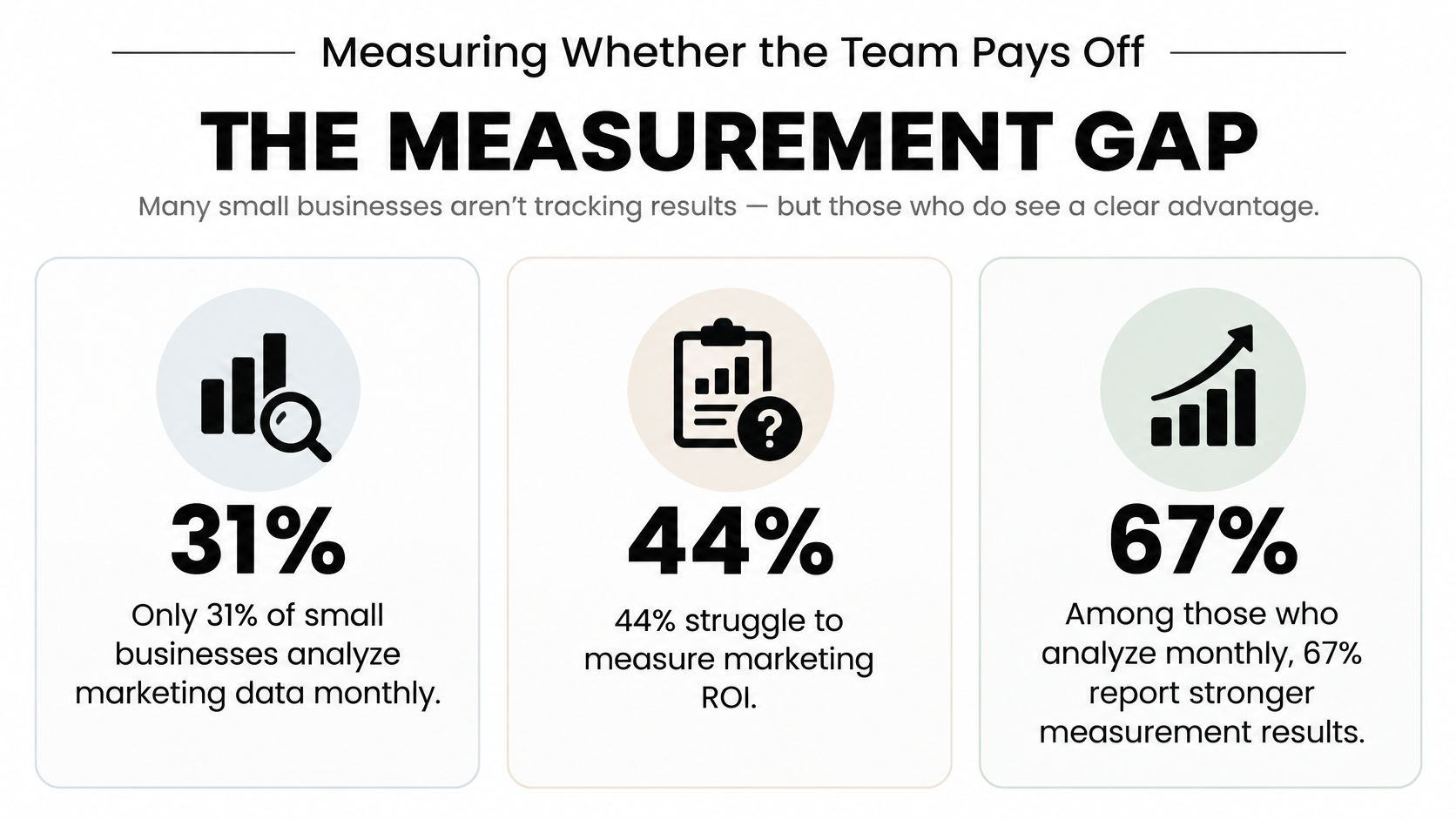
The reading is uncomfortable but useful. The problem may not be too little content. It may be too much content published before anyone built a loop that says which content did something.
Reach and engagement are diagnostic signals, not proof of business impact. A post with 400 impressions that prompts two direct messages from target accounts beats one with 4,000 impressions and silence.
| Metric tier | Examples | Question it answers | Review cadence |
|---|---|---|---|
| Diagnostic | Reach, engagement, profile views | Is the content being seen? | Weekly |
| Outcome | Qualified conversations, direct messages from target accounts, referrals citing a post | Is the right audience responding? | Monthly |
| Business | New leads, sales conversations, attributed revenue | Is the work paying off? | Quarterly |
A consultant who tags every post by theme and asks each new lead what prompted contact usually finds something surprising in the first quarter. Say the posts split into pricing mistakes, hiring, and industry news. The pricing post produces four qualified conversations, the hiring post one, and the industry news posts none, despite carrying the best engagement numbers. That's the kind of finding a weekly reach check can never produce.
Rule for scaling: if the team can't yet name which themes create qualified conversations, hold output steady and improve the measurement loop. Adding volume to an unmeasured process multiplies the noise.
Start With One Structure This Month
Four weeks can test whether a marketing structure works without committing to more headcount.
Week one, choose the model. Use realistic owner hours and available budget to select a staffing model. Then assign a person to direction, expertise capture, production and review, and publishing and analysis. One person can own several jobs, but every job needs an owner.
Weeks one to four, run the workflow. Keep editorial decisions with the person who knows the business and its audience. Delegate production tasks that can follow a written brief, and make review times clear so work does not stall between handoffs.
At the end of week four, review diagnostic metrics and outcome metrics. Decide whether the process is ready for more output or needs another month of refinement. More posts will not solve unclear ownership or weak measurement.
The main constraint is often the owner's time and editorial judgment, not the number of people on the team. Use a small, repeatable workflow first, then scale only when the measurement loop shows which themes lead to qualified conversations.
To see how an expertise-led LinkedIn workflow is organized, visit PostToGo and select Explore demo to switch between the Ideate, Plan, and Schedule examples. The demo uses preset examples and does not connect to LinkedIn, generate live content, save a content plan, or publish or schedule real posts.